
Self-employed mortgage lender websiteMortgage website examples for loan officers →
Say yes to the borrowers a W-2 checklist turns away
Five income routes explained side by side, with the document list settled before your first phone call.
- Pages
- 61
- Screens below
- 5
- Status
- Live
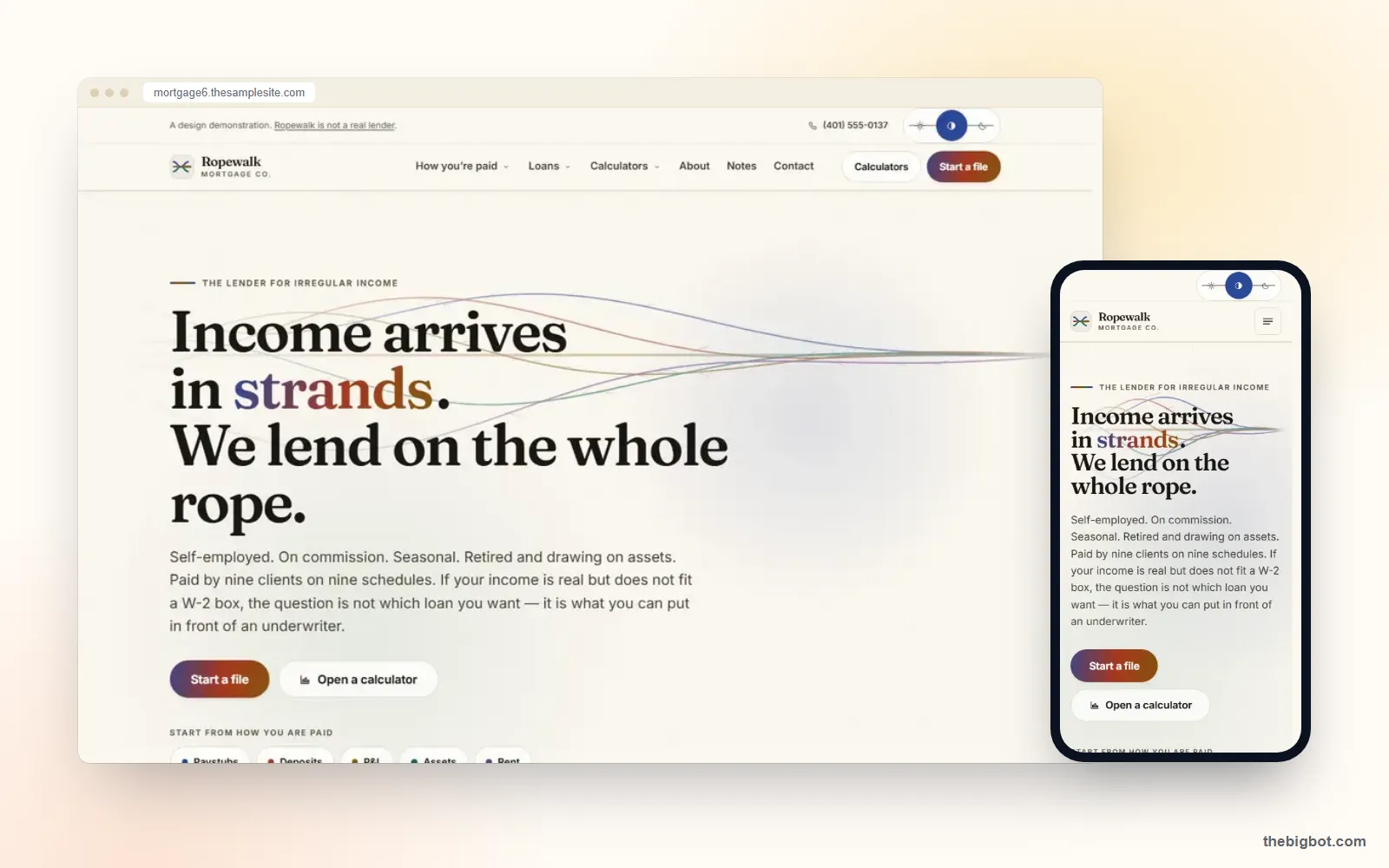
Every screen of Ropewalk
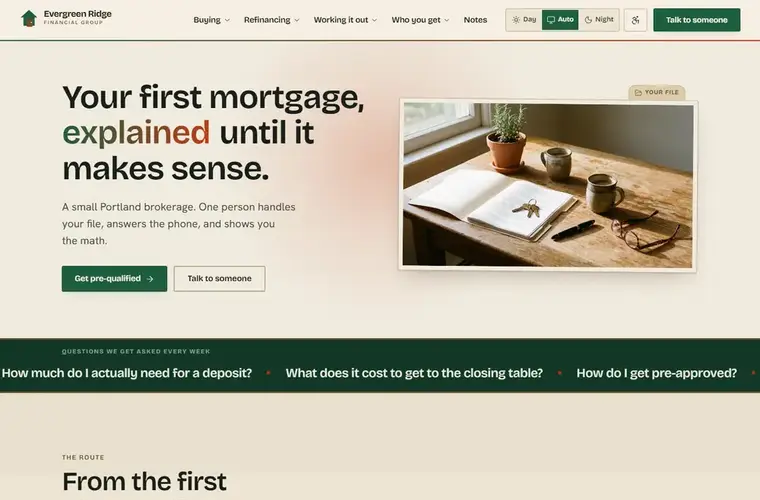
Captured from the live Ropewalk Mortgage Co. demo: the income-first home page, the loan options routes, about and contact.




Where Ropewalk wins
Ropewalk is built for a lender whose borrowers do not fit a W-2 box: business owners, contractors, commission earners and seasonal workers. The site starts from how a borrower is paid and shows the documents each route needs.
Lenders serving irregular-income borrowersIncome comes first, product second
Visitors choose how they are paid, then see the loans that fit, which is how a self-employed borrower actually thinks.
Five routes, compared openly
Paystubs, bank statements, profit and loss, assets and rental income sit side by side with the documents each one needs.
Fewer document surprises
Checklists mean the file arrives closer to complete, which shortens the part of your week that is chasing paperwork.
Also on the site
Income-first navigation. Visitors choose how they are paid before they choose a loan.
Five documentation routes. Paystubs and W-2s, bank statements, profit and loss, assets and rental income.
Document checklists. Each route lists exactly what the borrower hands over.
Affordability calculator. Deposit-based income with an expense factor applied.
How self-employed borrowers qualify, route by route
Self-employed borrowers are usually told what they cannot do. These are the routes Ropewalk explains instead, with the general rule behind each. Lender overlays vary.
Tax returns
Agency loans generally look for a two-year history of self-employment, documented with personal and business tax returns. Write-offs that lower taxable income also lower qualifying income.
Bank statements
Non-QM programs qualify on deposits over 12 or 24 months of personal or business statements, with an expense factor applied to business accounts.
Profit and loss
Some programs accept a P&L statement, often prepared or signed by a CPA or tax preparer, in place of full returns.
Asset depletion
Liquid assets are divided over a set number of months to produce a qualifying income, which suits retirees and savers with uneven earnings.
Ability to repay still applies
Non-QM does not mean no documentation. Federal ability-to-repay rules still require the lender to verify income or assets in good faith.
Sources: Fannie Mae Selling Guide B3-3.2-01 (self-employed borrowers), Regulation Z § 1026.43 (ability to repay).
Rebuilding Ropewalk as your site
Ropewalk starts from how a borrower is paid, so the rebuild centers on the documentation routes you actually underwrite.
- Routes matched to your investors. The five income routes are kept or removed based on the bank statement, P&L, asset and rental income programs you can place.
- Checklists in your wording. Each route’s document list is rewritten to your requirements, such as 12 or 24 months of statements, so the file arrives complete.
- Expense factor set to your programs. The deposit-based affordability calculator uses the expense factor your lenders apply, labeled as an estimate.
Pick Ropewalk if
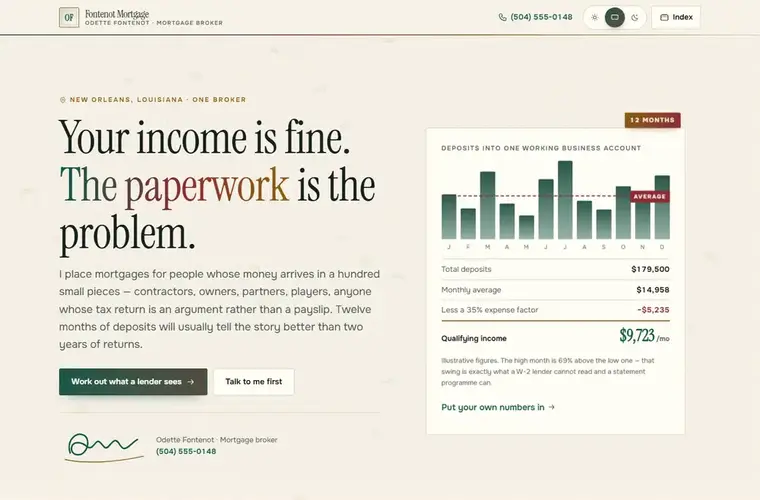
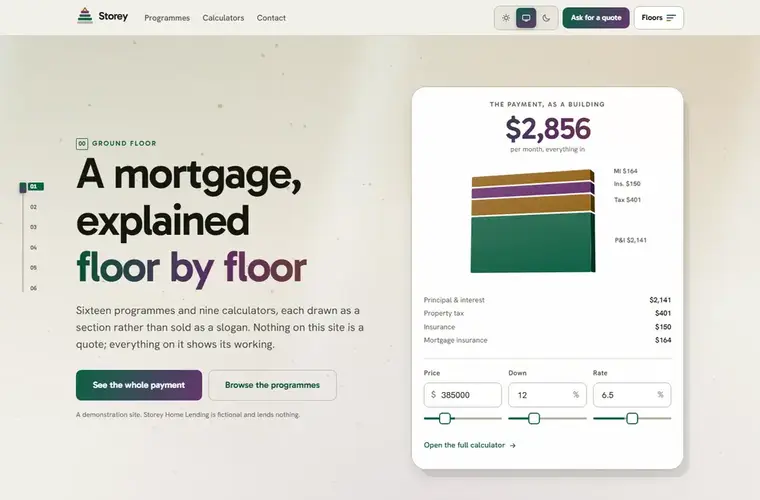
If not, Fontenot or Storey may suit you better.
- Half your borrowers are self-employed, contract or commission paid
- You explain bank statement and P&L qualifying on every call
- You want the document list handled before the first conversation
Questions about Ropewalk
Who should use the Ropewalk design?+
Does Ropewalk explain bank statement loans?+
What documents does a bank statement loan need?+
Is Ropewalk only for non-QM lenders?+
Launch Ropewalk as your website.
Five income routes with your document lists, rebranded on your own domain.
Book a Demo →